Ex-Blue Cross spokesman says health insurance ‘worst product in American history’
By Raw Story
Teaming with the liberal Brave New Films, a former Blue Cross pitchman is now pitching against Blue Cross.
Andy Cobb, who once tried to sell Floridians on a Blue Cross health insurance plan, says he’s fed up with the industry.
“I was a spokesman for BlueCross and Blueshield of Florida,” Cobb says. “Call me a spokesjerk. People who make money for buying things you don’t need. And we’re telling you lies.”
“They, by which I mean I, make money by standing in the way of reform,” Cobb says in the ad, which appears as a spoof of something like a freecreditreport.com ad. “It’s time for change.”
“That’s why I’m calling on leaders from the spokesjerk industry,” Cobb continues. “The freecreditreport.com guy. The Shamwow dude. And Senator Bill Nelson, recipient of big money from insurance companies — to lead us. To walk away from their cash cows and tell American people the truth.
“And us spokesjerks, we’ll be fine,” Cobb adds. “There’s plenty of room in entertainment for people who tried to sell you the worst product in American history. Private health insurance.”
Exclusive: Sanders Tackles Too Big To Fail In Two Pages
By Sam Stein at Huffington Post
Senator Bernie Sanders (I-VT) introduced new legislation on Friday that should, he claims, solve the phenomenon of massive and failing financial institutions holding the nation’s economy captive.
It’s all of two pages long.
The Vermont Democrat-Socialist unveiled the “Too Big to Fail, Too Big to Exist Act” — which he billed as a succinct remedy for tackling financial risk and avoiding a repeat of the taxpayer-funded bailouts that occurred just one year ago.
The act is straightforward. It would require that 90 days after its passage, Treasury Secretary Tim Geithner “submit to Congress a list of all commercial banks, investment banks, hedge funds and insurance companies that the Secretary believes are too big to fail.”
Subsequently, one year after the law is enacted, the Treasury Secretary would be required to “break up entities included on the Too Big To Fail List, so that their failure would no longer cause a catastrophic effect on the United States or global economy without a taxpayer bailout.”
The rest of the details — like, say, how to do that, how the broken-up entities would be structured, and what authorities would be granted for preempting institutions from becoming too big to fail in the first place — would be filled in during the legislative process, Sanders’s office said. The goal is simply to immediately preempt a duplication of last year’s economic meltdown.
Former Blue Cross Blue Shield ‘Spokesjerk’ Cuts Ad In Favor Of Health Reform
By Zaid Jilani at Think Progress
The House is nearing a vote on health care legislation that is expected to be very close. At this critical juncture, a former Blue Cross Blue Shield spokesperson is doing what he can to help pass reform.
Actor and comedian Andy Cobb, who used to be the spokesman for Blue Cross and Blue Shield of Florida, has teamed up with Robert Greenwald’s Brave New Films project “Sick for Profit” to produce a new ad in favor of health care reform. In the ad, Cobb calls himself a former “spokesjerk” for Blue Cross and Blue Shield of Florida, and says that his job was to “sell you the worst product in American history: private health insurance.” Cobb calls attention to Sen. Bill Nelson (D-FL) for his signficant contributions from the health care industry, and asks him to vote in favor of health care legislation with a public option. Watch it:
This morning, Democracy Now’s Amy Goodman interviewed Cobb. He told her, echoing remarks from Rep. Dennis Kucinich (D-OH), “This is the time when we have to say, ‘Which side are you on? The insurance companies or the American people?’ And for too long I’ve been on the wrong side of that.”
Rethink Afghanistan: Pull out or stay in?
After eight years of U.S. military engagement in Afghanistan, violence and instability still prevail. The military approach to Afghanistan is not succeeding; further application of American military force will not bring stability to the country or security to our own.
With over 90 percent of U.S. funding in Afghanistan directed toward military purposes, non-military strategic options are not being pursued. The problems facing Afghan society are economic, social and political in nature, and require economic, social and political solutions. The U.S. can play a more constructive role in Afghanistan by engaging civil society than by waging war.
For more information: http://rethinkafghanistan.com/
Veterans groups boost lobbying
With a White House decision on the direction of the war in Afghanistan still up in the air, and President Barack Obama considering whether to send as many as 40,000 additional U.S. troops, veterans groups on opposite sides of the debate are storming Capitol Hill this week to sway congressional opinion.
With U.S. deaths in Afghanistan rising and the Taliban resurgent, officials from the hawkish Veterans for Freedom and the dovish Veterans for Rethinking Afghanistan said they are increasing their lobbying campaigns to dramatically change how America conducts the eight-year war.
Veterans for Freedom kicks off Thursday at the District of Columbia’s American Legion post with a breakfast and strategy session, followed by a meeting with Rep. Marsha Blackburn (R-Tenn.), who represents the district where part of Fort Campbell — the military base that houses the 101st Airborne Division — is located.
After a news conference, and armed with embedded media, a group of 50 to 100 veterans will fan out across Capitol Hill for meetings with the staffs of key senators, including Majority Leader Harry Reid, Democrats John Kerry of Massachusetts and Jim Webb of Virginia and Republicans John McCain of Arizona and John Cornyn of Texas.
“This is a very important litmus test for Obama,” said Pete Hegseth, chairman of the group and a supporter of surging more U.S. forces into Afghanistan. He noted that, during the campaign, Obama called Afghanistan the “good war” and has endorsed continuing to fight a counterinsurgency there.
If Obama backs a request by Gen. Stanley McChrystal, the top U.S. commander in Afghanistan, to send more U.S. forces to the country, “we’ll stand right next to them and support that,” Hegseth said.
On the other side of the issue is Veterans for Rethinking Afghanistan, a relatively new group, with a handful of members, that is trying to persuade lawmakers that U.S. war strategy in Afghanistan is a massive failure and that the military is part of the problem.
The group is starting to receive notice in the national media, particularly after a debate it had this week against Veterans for Freedom. Veterans for Rethinking Afghanistan met with the staff of the Senate Foreign Relations Committee and will check in with anti-Iraq war Democrats — including Sen. Russ Feingold of Wisconsin and Reps. Raul Grijalva of Arizona and Lynn Woolsey and Barbara Lee of California — trying to stuff their briefing books with reasons to end the military commitment to Afghanistan.
“Listen, you’ve got to stop falling in love with the military solution; it’s not feasible,” said Jake Diliberto, one of the group’s founders. “This is a war of poverty and cultural misunderstanding, and it’s an Afghan problem that we don’t have the means or the wisdom to figure out.”
In between the two groups is VoteVets.org, a veterans group with closer ties to the Democratic Party that has staked out the middle ground and is watching this week’s lobbying activities from the sidelines.
In 2007, Veterans for Freedom supported the surge of U.S. forces in Iraq, and VoteVets.org opposed it, advocating a drawdown from Iraq instead. But for now, the organization is still debating its position on the war in Afghanistan, said VoteVets Chairman Jon Soltz, and it is concentrating its efforts on climate change.
“The only mission that we think we’re sure can be successful is the military option,” Soltz said. But that’s not a matter of simply beefing up troops, he said, and it doesn’t address questions about whether Afghan President Hamid Karzai is a legitimate political partner, how much Pakistan cooperates inside its own territory in the fight against Al Qaeda and whether the U.S. government can provide the kind of humanitarian support and reconstruction that is required to boost security in Afghanistan.
VoteVets wants to see how the White House defines the goals of a troop buildup, Soltz said. “We’re waiting to see how they define success and whether these other elements can be achieved.”
Of the three groups, Veterans for Freedom has the most extensive lobbying background. The organization began in 2005 and helped cement support for the U.S. troop surge in Iraq by saturating Washington with advertising and sending 400 of its members to the Hill on two occasions to twist arms.
And history suggests that if Obama does not support McChrystal’s request for more troops, Veterans for Freedom may turn on the president. The group actively ran a whisper campaign in western Pennsylvania to defeat Democratic Rep. John Murtha and has backed a slate of largely Republican veterans for Congress.
The group’s founder, David Bellavia, who in 2008 ran unsuccessfully for Congress in New York, attacked Kerry and the late Sen. Ted Kennedy in 2005 for supporting statements that Iraqis wanted the United States to leave their country, claiming in an article on FrontPageMag.com that the comments were “a political attack on the troops, an attack that is aiding our enemy.” The publication is run by Holocaust denier David Horowitz.
With the U.S. drawing down in Iraq and on the brink of ramping up in Afghanistan, Bellavia’s group is now courting Kerry and says it has a meeting scheduled at the White House to discuss war strategy. That’s completely consistent, Hegseth said, because Veterans for Freedom is dedicated to a single issue: winning the wars in Iraq and Afghanistan.
The newest group, Veterans for Rethinking Afghanistan, has outside backing from Brave New Films and its president, liberal activist and filmmaker Robert Greenwald, who created documentaries including “The Real McCain” and “Outfoxed: Rupert Murdoch’s War on Journalism.” Greenwald has been a regular donor to liberal members of Congress and supported Kerry’s 2004 presidential bid.
Members of the group say that one of the arguments they will make to lawmakers on Capitol Hill is that the price of remaining in Afghanistan is simply too high. Leighton Akio Woodhouse, political director for Brave New Films, asserted that supporting one soldier for one year costs American taxpayers $1 million.
“The American people need to be aware of exactly what a counterinsurgency means,” said former Marine Sgt. Devon Read, a member of the group who served in Iraq. “A counterinsurgency campaign is going to mean not 40,000 troops but 150,000 troops or more, 10 years of a presence in Afghanistan and tens of thousands more dead troops.”
Former BlueCross Pitchman Switches Sides, Comes Out For Public Option
By Ryan Grim at Huffington Post
Andy Cobb has had enough. A former pitchman for BlueCross Blue Shield of Florida, Cobb is breaking with the firm and speaking out in favor of health care reform and a public health insurance option.
“This is the time when Americans have to choose which side we’re on,” Cobb told HuffPost, quoting Rep. Dennis Kucinich (D-Ohio). “Is it the insurance companies or the American people?”
Cobb calls on what he dubs his fellow “spokes-jerks” — singling out the FreeCreditReport.com guy — to stop hawking products that hurt the American people.
Cobb teamed with Brave New Films to create the short video.
“I do know that 19 percent of every dollar of our premiums goes to administrative costs, for executive compensation and people like me. We can’t afford people like me any more in this country,” he said.
Afghan war veterans debate merits of troop surge
President Obama is expected to make a decision on troop levels in Afghanistan in the coming weeks. His top commander in Afghanistan wants at least 40,000 more soldiers. Is that the right number? Should we be sending more troops at all?

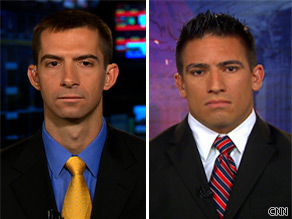
Two veterans of the war, Thomas Cotton and Jake Diliberto, will be lobbying Congress on opposite sides of the troop surge divide. They spoke to John Roberts on CNN’s “American Morning” Monday. Below is an edited transcript of that interview.
John Roberts: Thomas, let’s start with you. What’s the pitch that you’re going to make in favor of General Stanley McChrystal’s call for some 40,000 additional troops in Afghanistan?
Thomas Cotton: I’m going to tell Congress that we need every last one of those troops. That’s based not only on my experience over the last year in Afghanistan, but also on General McChrystal’s reputation and expertise. He has spent a career in the Army Special Operations community and he’s looked at this situation carefully and knows that we can’t win with a counterterrorism strategy only.
We need a full-spectrum counterinsurgency that can secure the south and the east while mentoring and training the Afghan national army. And 40,000 troops is the absolute minimum with which he can accomplish that mission.
Roberts: Jake, you heard Thomas’ argument. What’s your argument against the surge in troops in Afghanistan?
Afghan War Vets Patrol Halls Of Congress To Stop Troop Escalation
By Ryan Grim at Huffington Post
A little more than two months ago, Brock McIntosh was fighting in Afghanistan, a member of the Army National Guard. This week, he’s walking the halls of Congress, trying to end a war that began when he was 13 years old.
McIntosh, now 21, and four other vets are in Washington for something of a preemptive strike. A new pro-war group calling itself Vets For Freedom plans to begin lobbying Congress Thursday, pushing for an escalation. The anti-war vets hope to head them off.
But if their erstwhile comrades and now political opponents are “for freedom,” that raises an unusual question. “What does that make us?” Devon Read, 29, asks mockingly. “Vets Against Freedom? Vets For Terrorism?” Read served for eight years and took part in the invasion of Iraq before leaving the Marine Corps in 2008.
Technically, the soldiers are part of Iraq Veterans Against the War, but most are Afghan veterans who have linked up with Brave New Films president Robert Greenwald, whose documentary project “Rethink Afghanistan” urges a drawdown of the American presence in that country.
As the vets wait outside the office of Rep. Raúl Grijalva, a Democrat who co-chairs the Congressional Progressive Caucus, Jake Diliberto, 27, recounts tales from the first skirmish with Vets For Freedom earlier in the morning.
Diliberto went mano a mano on CNN with VFF rep Thomas Cotton. Cotton had a simple appeal to authority: He’s for whatever General Stanley McChrystal wants — and that’s more troops.
Before they went on, says Diliberto, he could hear his opponent prepping himself. “He kept repeating, ‘General Stanley McChrystal. General Stanley McChrystal. General Stanley McChrystal.’ ”
Backers of escalating the eight-year-old war present a variety of complex arguments, but at their heart is Cotton’s mantra: “General Stanley McChrystal. General Stanley McChrystal. General Stanley McChrystal.”
The troops were joined in Grijalva’s office by Malalai Joya, an Afghan member of parliament who has been suspended for speaking out against the warlords who run the country. She is appealing her suspension and, in the meantime, promoting her new book, “A Woman Among Warlords.” Joya, too, has a simple message: Go home, USA.
“It’s much easier to fight against one enemy than two,” Malalai Joya tells Grijalva, identifying the two current enemies as the Taliban on the one hand and the United States and the Afghan government it props up on the other.
The Afghan government, she says, is hopelessly corrupt; President Hamid Karzai is in league with powerful warlords and druglords, some of whom are his close relatives. His top opponent, Abdullah Abdullah, is himself a well-known warlord, she says. The election process is controlled by warlords for their benefit. The farce that was the previous election will not lead to a run-off because Abdullah doesn’t believe it will be fair.